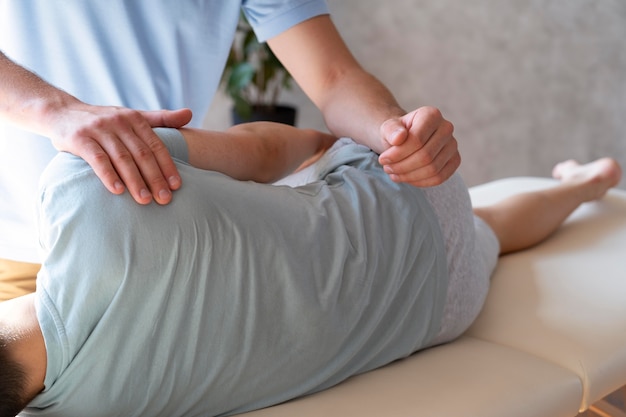


Can you exercise with back pain? In many cases, yes — but the type, timing, and intensity of movement matter. Exercising with back pain can be safe and helpful in many cases, but the right type, timing, and intensity of movement matter.
Gentle, low-impact exercise can support recovery, reduce stiffness, improve circulation, and strengthen the muscles that protect your spine.
With professional guidance, you can perform exercises like walking with back pain, swimming, and specific stretching for back pain. Movements such as the Cat-Cow stretch, pelvic tilts, and glute bridges help by improving mobility and strengthening your core support muscles. The key is to avoid high-impact activities or any movement that causes sharp, radiating pain. Before starting any new routine, getting a precise diagnosis from a trusted professional is essential. This ensures your workout is individually suited to your specific condition, promoting healing instead of harm.
This guide will explore the modern approach to movement, safe exercises for back pain you can do, and how to listen to your body’s signals. Let’s delve into how you can stay active and support your recovery.
Key Takeaways
-
Movement for back pain is often more beneficial than prolonged bed rest for many types of back pain.
-
Learning to differentiate between safe discomfort and harmful pain signals is essential for active recovery.
-
Personalised assessment from professionals like Spinal Care is vital before starting an exercise routine.
-
Low-impact aerobic activities, targeted stretches, and core strengthening are generally recommended.
-
Lifestyle factors, including posture and back pain, ergonomics, weight, and stress, significantly impact spinal health.
Jump to section
- Can You Still Exercise With Back Pain? The Modern View
- How to Listen to Your Body: Safe Discomfort Versus Harmful Pain Signals
- What Are the Safest and Most Effective Exercises for Back Pain?
- What Exercises Should You Modify or Avoid with Back Pain?
- Beyond Exercise: Holistic Strategies for Managing Back Pain
- Empowering Your Path to Pain-Free Movement
- Frequently Asked Questions
Can You Still Exercise With Back Pain? The Modern View
Exercising with back pain is not only possible but often recommended as a core part of recovery. The modern medical view has shifted dramatically from prescribing complete bed rest to advocating for gentle, controlled movement. For most cases of mechanical back pain, engaging in appropriate physical activity helps maintain spinal health and accelerates healing. In contrast, remaining sedentary can lead to increased stiffness, weaker muscles, and a longer recovery time.
The understanding of back pain has evolved. We now recognise that our spines are designed for movement for back pain. Inactivity can cause the very muscles that support your back to weaken, making you more susceptible to further strain. According to the Australian Institute of Health and Welfare, back problems are a leading cause of disability in Australia, highlighting the need for effective management strategies like therapeutic exercise — a position supported by research on the Low Back Pain: Evaluation and management framework. A carefully considered back pain workout routine helps you regain function and confidence.
Why Prolonged Bed Rest Can Worsen Back Pain
The old advice to stay in bed for days with back pain can actually be counterproductive. Prolonged bed rest often worsens the condition by creating a cycle of stiffness and weakness. When you don’t move, the muscles supporting your spine begin to lose strength and endurance, a process known as atrophy. This makes your back less stable and more prone to injury when you eventually do become active again. This answers the question: should you rest back pain? For most cases, not for long.
Furthermore, inactivity reduces lubrication in your spinal joints, leading to increased stiffness and discomfort. Blood flow to the affected area also decreases, which is a problem because circulation delivers essential nutrients and oxygen for tissue repair. This slowdown in the healing process can be accompanied by a psychological impact. The fear of movement, known as kinesiophobia, can develop, making you anxious about physical activity and further limiting your recovery.
“Movement is medicine, especially for the spine. Prolonged rest only serves to decondition muscles and stiffen joints, making the road to recovery longer and more challenging.” – A common adage in rehabilitation.
The Science-Backed Benefits of Movement for Spinal Health
Science strongly supports the idea that the right kind of movement is medicine for back pain, as demonstrated by recent research evaluating the Benefits and harms of exercise therapy and physical activity for low back pain. Engaging in appropriate exercise delivers a range of physiological benefits that directly contribute to spinal health and pain reduction. Active recovery helps improve the strength, flexibility, and endurance of the muscles that form your core and support your spine, creating a natural corset of protection.
Movement improves circulation, thereby delivering a steady supply of oxygen and nutrients while flushing out inflammatory by-products. This process is essential for healing. Regular activity also boosts joint mobility and reduces stiffness by encouraging the production of synovial fluid, which lubricates the joints. It helps re-educate muscles, improving motor control and fostering better movement patterns, which are vital for effective back pain recovery tips. On a neurological level, exercise prompts the release of endorphins, your body’s natural painkillers, which can reduce your perception of pain. At Spinal Care, our philosophy is non-invasive and movement-positive, focusing on empowering you to manage back pain through safe and effective activity.
How to Listen to Your Body: Safe Discomfort Versus Harmful Pain Signals
Learning to interpret your body’s feedback is one of the most important skills when you exercise with back pain. It is normal to feel mild discomfort or a gentle stretching sensation during rehabilitative exercises. This often indicates that tight muscles are lengthening and stiff joints are beginning to mobilise. This “safe” discomfort should feel therapeutic and typically subsides shortly after you stop the activity.
However, there is a clear line between this productive discomfort and harmful pain. You must stop immediately if you experience sharp, stabbing, or radiating pain. These sensations are warning signals from your body that you might be irritating a nerve or causing further tissue damage. Pushing through this type of pain will only set your recovery back. The goal is to work within a comfortable range of motion, not to test your pain threshold. It is also important to remember that progress often comes with gradual progression. Start with fewer repetitions or shorter durations, and slowly increase as your body adapts. If a movement feels too intense, scale it back or choose an easier modification. The aim is consistent, gentle improvement, not sudden, drastic changes.
Understanding “Red Flag” Symptoms Requiring Immediate Professional Assessment
While most back pain can be managed with gentle exercise and professional guidance, some symptoms are considered “red flags” that require immediate medical attention. These signals suggest a more serious underlying condition that needs to be properly diagnosed and treated. Do not attempt to exercise through these symptoms.
Seek urgent professional help if you experience any of the following, as these may indicate when back pain is serious and requires immediate attention:
-
Constant and severe pain that does not ease with rest or changing positions.
-
Pain that is strong enough to wake you up from a deep sleep at night.
-
Pain that radiates down one or both legs, especially if it travels below the knee. This is a common sign of sciatica.
-
Numbness, tingling, or significant weakness in your legs, groin, or pelvic area.
-
Loss of bowel or bladder control, which may indicate a rare but serious condition called cauda equina syndrome.
When to Seek Expert Guidance From Spinal Care
It’s time to seek professional help when your pain worsens with exercise or if you see no improvement after a period of self-management. Continuing with exercises that aren’t working is not a good strategy. A precise diagnosis is the foundation of effective treatment, which is why the team at Spinal Care utilises a comprehensive Bio-Psychosocial Assessment and Precision Diagnostics. This allows us to understand the true source of your pain.
Many people develop a fear of movement (kinesiophobia) after an injury, which can be a major barrier to recovery. At Spinal Care, we address this directly with our specialised CBT-informed pain education. We help you understand the difference between hurt and harm, empowering you to re-engage with activity safely. If you live near Ingleburn or Kogarah Bay, a consultation with our professionals can provide you with a personalised plan to get you moving again with confidence.
What Are the Safest and Most Effective Exercises for Back Pain?
The safest exercises for back pain focus on low-impact, controlled movements that build support without aggravating your symptoms. A well-rounded routine should include a mix of gentle aerobic conditioning, targeted stretching for flexibility, and exercises to strengthen your core and surrounding muscles — an approach reinforced by findings from Evaluating the effectiveness of six exercise interventions for low back pain. The goal is to restore function and build resilience against future episodes of pain.
Avoid a one-size-fits-all approach. The best exercises for you will depend on the specific cause of your back pain. A professional assessment is the best way to determine which movements are most appropriate for your condition. However, several categories of exercise are generally considered safe and beneficial for most types of mechanical back pain, particularly for exercising with lower back pain.
Gentle Low-Impact Aerobic Activities to Support Your Spine
Low-impact aerobic exercise is excellent for improving overall fitness and promoting healing without placing excessive stress on your spine. These activities increase blood flow, which delivers nutrients to injured tissues and helps reduce inflammation. They are a great way to ease back into exercising with lower back pain.
Here are some highly recommended low-impact options:
-
Walking: This is one of the most accessible exercises for back pain. Start with short, 10-15 minute walks on a level surface. Focus on your posture and engage your deep core muscles by gently drawing your belly button toward your spine. This creates an internal brace that contributes to lower back pain relief.
-
Swimming and Pool-Based Exercises: The buoyancy of water supports your body weight, taking the load off your spinal discs and joints. Water aerobics or simply walking in the pool provides gentle resistance to strengthen muscles. As you get stronger, you can progress to paced swimming.
-
Cycling: A stationary bike is a great way to get a cardiovascular workout with minimal impact. Ensure the bike is set up correctly to maintain good posture, avoiding a hunched-over position that could strain your back. At Spinal Care, we provide guidance on personalised exercise plans suitable for various conditions, including osteoarthritis.
Targeted Stretches and Mobility Exercises for Pain Relief
Stretching for back pain and mobility work are vital for relieving muscle tension, improving flexibility, and restoring a healthy range of motion in your spine. These movements should always be performed slowly and gently, without any bouncing or forcing. The aim is to move within a comfortable, pain-free range.
Consider incorporating these beneficial stretches into your routine:
-
Knee-to-Chest Stretch: Lie on your back and gently pull one or both knees toward your chest. This helps to elongate the muscles and relieve tightness in your lower back.
-
Supine Rotational Stretch: While lying on your back with your knees bent, slowly lower both knees to one side while keeping your shoulders flat on the floor. This provides a gentle twist that improves mobility in your lumbar spine.
-
Cat-Cow (Cat Stretch): On your hands and knees, slowly arch your back up toward the ceiling (cat), then gently lower your stomach toward the floor (cow). This movement promotes gentle flexion and extension without loading the spine.
-
Back Pocket Stretch (Standing Extension): Stand and place your hands on your lower back as if putting them in your back pockets. Gently arch backward over your hands to counteract the effects of prolonged sitting.
-
Pelvic Tilts: Lie on your back with your knees bent. Gently flatten your lower back against the floor, then create a small arch. This micro-movement is great for releasing tension.
Strengthening Your Core and Supporting Musculature for Long-Term Health
A strong and stable core is your best defence against back pain, a conclusion supported by Frontiers | Effects of different exercise interventions on lower back pain, which confirms the role of targeted strengthening in pain reduction. Your core includes not just your abdominal muscles but also the muscles in your lower back, hips, and glutes. Strengthening this entire support system is key to long-term spinal health and effective chronic back pain exercise.
Focus on exercises that build endurance and stability:
-
Glute Bridges: Lie on your back with knees bent. Lift your hips toward the ceiling, squeezing your glutes at the top. This strengthens the glutes and lower back, which are essential for pelvic stability.
-
Lateral Leg Lifts: Lying on your side, slowly lift your top leg without rocking your torso. This targets the hip abductor muscles, which help align your pelvis and lower back.
-
Partial Curls: A safer alternative to full sit-ups, partial curls strengthen the abdominal muscles without putting excessive pressure on your spinal discs. Lift only your head and shoulders off the floor.
-
Deep Core Conditioning (Bird-Dog and Planks): The Bird-Dog exercise involves extending the opposite arm and leg while on all fours, teaching your core to stay stable while your limbs are in motion. Planks build endurance in the entire core musculature. Spinal Care emphasises customised programmes that combine adjustments with these targeted exercises to improve function.
What Exercises Should You Modify or Avoid with Back Pain?
While movement for back pain is beneficial, some exercises can put too much stress on a vulnerable spine and should be modified or avoided, especially during an acute flare-up of pain. High-impact activities that send shockwaves through your body can irritate inflamed discs and joints. Similarly, movements that involve heavy loading or combine bending with twisting can be risky. Knowing what exercises to avoid with back pain is just as important as knowing what to do. The goal is to stay active without causing further injury. A professional can provide specific guidance based on your diagnosis, but there are some general rules to follow.
High-Impact Activities and Heavy Lifting: When to Proceed with Caution
High-impact activities and heavy lifting place significant mechanical stress on the spine. If your core is not strong enough or your form is incorrect, these movements can easily lead to injury or aggravate an existing condition. It is wise to pause these activities until your back has healed and you have rebuilt foundational strength.
Be cautious with the following:
-
Activities like running (especially on hard surfaces), jumping, and skipping.
-
Heavy weightlifting exercises like deadlifts and barbell back squats that place a direct compressive load on the spine.
-
If you’re an athlete, the sports injury rehabilitation programmes at Spinal Care focus on accurate diagnosis and proper technique to help you return to your sport safely.
Common Exercise Mistakes and How to Avoid Them
People often make common mistakes when trying to exercise with back pain, which can unfortunately make things worse. One of the biggest errors is pushing through sharp pain instead of listening to your body’s warning signals. Another is ignoring proper form, which can lead to faulty movement patterns and further strain.
Avoid these common pitfalls:
-
Performing conventional full sit-ups, which place immense pressure on your lumbar discs.
-
Doing standing toe touches with straight legs, which can overstretch lower back ligaments and irritate the sciatic nerve.
-
Sacrificing proper form for speed or more repetitions, such as allowing a “butt wink” (pelvic tilt) at the bottom of a squat.
-
Forgetting to warm up before exercising or cool down afterward. A proper warm-up for back pain prepares your muscles, while a cool-down helps prevent stiffness and promotes back pain recovery tips.
-
The team at Spinal Care is committed to providing personalised recommendations to help you exercise effectively and avoid these mistakes.
Beyond Exercise: Holistic Strategies for Managing Back Pain
Managing back pain effectively requires a holistic approach that goes beyond a 30-minute workout. Your daily habits, work environment, and mental well-being all play a significant role in your spinal health. True, long-term relief comes from integrating positive changes across all areas of your life, a principle backed by Frontiers | Exercise prescription for improving chronic low back pain, which highlights the importance of individualised, multi-dimensional intervention strategies. This means paying attention to your posture, managing your weight, and addressing stress.
Spinal Care champions a comprehensive, bio-psychosocial framework for this very reason. We recognise that pain is a complex experience influenced by physical, psychological, and social factors. By addressing the whole person, we help you build a resilient foundation for a pain-free, active life.
The Critical Role of Posture and Ergonomics in Spinal Health
Your posture and back pain are closely linked; your daily ergonomics have a constant impact on your spine. Poor posture, such as slouching over a desk for hours, places sustained stress on your spinal discs and supporting muscles, often leading to chronic back pain. Improving your posture is a form of active recovery that you can practice all day long.
“Think of your spine as a stack of building blocks. If they’re aligned, the structure is stable. If they’re out of alignment, stress points develop, leading to discomfort and potential injury.” – Ergonomics Specialist.
Think about your alignment throughout the day by using the “plumb line visualisation,” imagining a straight line running from your ear through your shoulder, hip, knee, and ankle. Simple actions like scapular retraction (gently squeezing your shoulder blades together) can instantly correct rounded shoulders. For office workers, Spinal Care offers personalised ergonomic assessments in Ingleburn and Kogarah Bay to help you set up a workstation that supports, rather than strains, your spine.
Lifestyle Factors: Weight Management, Stress, and Sleep
Several lifestyle factors can significantly influence your back pain. Excess body weight, particularly around your midsection, can shift your centre of gravity forward and place continuous strain on your lower back. Losing even a small amount of weight can provide substantial lower back pain relief. Low-impact exercises like walking with back pain and swimming are excellent for weight management.
Psychological stress is another major contributor. Stress causes your muscles to tense up, which can trigger or worsen back pain. Techniques like diaphragmatic (belly) breathing can help calm your nervous system and release this tension. Finally, never underestimate the power of restorative sleep. Your body performs most of its tissue repair while you sleep, making quality rest essential for back pain recovery tips.
Spinal Care’s Comprehensive Approach to Back Pain Management
At Spinal Care, we address the multifaceted nature of back pain through our specialised 5-Step process. This process begins with a Bio-Psychosocial Assessment and Precision Diagnostics to get a complete picture of your health. From there, we provide Manual Treatment and CBT-Informed Pain Education to address both the physical and psychological components of your pain. We work with you on Functional Goal Setting to get you back to the activities you love.
Our targeted chiropractic adjustments restore joint mobility and relieve nerve pressure. Significantly, we use Cognitive Behavioural Therapy principles to help you overcome the fear of movement (kinesiophobia) that so often accompanies chronic pain. Whether you’re dealing with a sports injury, osteoarthritis, or work-related pain, our specialised care empowers you towards safe, active living.
Empowering Your Path to Pain-Free Movement
Essentially, understanding that you can exercise with back pain is the first step toward taking control of your recovery. Movement for back pain is a powerful tool for healing, but it must be applied wisely. By listening to your body, choosing the right activities, and avoiding common mistakes, you can build a stronger, more resilient back.
Remember that you don’t have to navigate this process alone. Personalised, professional guidance is the safest and most effective way to return to an active lifestyle. Take the proactive step of understanding your body and seeking expert support when you need it. To start your path toward pain-free movement, contact Spinal Care in Ingleburn or Kogarah Bay for a personalised assessment.
Frequently Asked Questions
Question: Is it safe and okay to exercise with back pain?
Yes, for most types of mechanical back pain, gentle, low-impact activity is not only safe but highly encouraged, as outlined in the clinical Low Back Pain: Evaluation and management guidelines from the NCBI. Movement for back pain helps maintain mobility, prevent muscle weakness, and promote blood flow essential for healing. However, it is vital that any exercise programme is guided by a professional diagnosis to ensure the activities are individually suited to your specific condition and are performed safely.
Question: What specific types of exercise might need to be modified or avoided entirely?
You should be cautious with high-impact activities like running and jumping, as they can compress the spine. Exercises to avoid with back pain or modify include those involving heavy loads, such as deadlifts, or extreme spinal bending, like traditional sit-ups, especially during acute pain. Your Spinal Care practitioner can provide explicit guidance on which movements are safe for your individual biomechanics and condition.
Question: How long does it realistically take for a back strain or sprain to improve?
Recovery times vary greatly depending on the severity of the injury, your overall health, and your adherence to a treatment plan. Minor muscle strains may feel better within a few weeks with proper care. However, more significant ligament or disc-related issues can take several months to heal. If your symptoms are not improving, a professional assessment at Spinal Care is recommended as part of comprehensive back pain recovery tips.
Question: Can breathing exercises genuinely help with back pain?
Absolutely. Your primary breathing muscle, the diaphragm, attaches directly to your lumbar spine. Chronic pain often leads to shallow chest breathing, which can create tension in these attachments. Deep diaphragmatic breathing helps release this mechanical tension and also calms the nervous system, which can reduce your perception of pain. It is an integral part of our holistic approach at Spinal Care.
Question: How does hip health, such as Hip Bursitis, relate to back pain?
The hips and lower back are linked in a biomechanical unit. A condition like hip bursitis can alter the way you walk, causing you to limp or shift your weight. This compensatory movement creates an asymmetrical load on your lower back, quickly leading to secondary pain. Therefore, treating back pain often requires a thorough assessment of hip function to ensure the entire kinetic chain is working correctly and to achieve lasting lower back pain relief.
Question: At what point should I seek professional healthcare intervention for my back pain?
You should seek immediate professional help if your pain is severe, constant, getting worse, or not improving after a few days of rest. It is urgent to seek care for “red flag” symptoms like significant leg weakness, numbness, or changes in bowel or bladder control, as these indicate when back pain is serious. An accurate clinical diagnosis from a professional at Spinal Care is the essential first step toward safe and effective management.